
Why do people do what they do, online?
There are numerous motivations behind the behaviors people exhibit in participatory media. Many follow long-held concepts that scientists recognize as common among all nations. In a survey of national cultures, sociologists in the mid 20th century highlighted three key issues imposing consequences on the integrity of societies (Inkeles & Levinson, 1997, pp. 45-51): relation to authority, conception of self, primary dilemmas and conflicts, and ways of dealing with them. Building on that milestone in culture-personality literature, Geert Hofstede published a highly-praised study that identified the values of people dealing with common problems, covering more than 50 countries. Hofstede’s conclusions were strikingly similar (Hofstede, Hofstede, & Minkov, 2010, p. 30). I’ll review their central themes, as they relate to online behaviors. Continue reading








 A growing number of people around the world are participating in online social media platforms, where floods of information are eroding barriers once imposed by national borders, religious convictions and governmental pressures. Nearly 4 out of 5 active Internet users visit online social networks and blogs, according to Nielsen (2011a). In business transactions, purchase decisions today rely more on consumer ratings and reviews than company sales pitches (Nielsen, 2011b). People are collaborating online about issues ranging from spending a dollar to the enforcement of policies. While sharing opinions in virtual venues, they’re rewriting definitions for socially acceptable beliefs, principles and activities. Mankind is distilling a kaleidoscope of data, discarding some elements, while debating and merging others. Controversial topics in online communities often explore concepts relevant to all of humanity, thereby programming minds with instructions formulated from a collective conscious. Social media is a participatory technology that’s rapidly consuming data, mixing ideas and homogenizing cultures.
 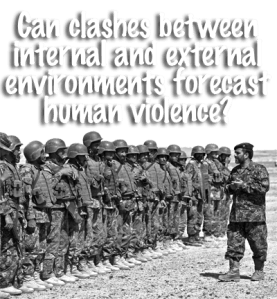 Around the world, humans are exhibiting a great capacity for compassion and social progress, as well as an equally grand tendency for cruelty. With advancements in material culture, our struggles for survival have become exceedingly more complex and unified and violent. According to the Geneva Declaration on Armed Violence and Development (Geneva Declaration Secretariat 2011), a Switzerland-based diplomatic initiative that identifies interrelations between global violence and development, more than 526,000 people die violently each year, of which 396,000 are the result of intentional homicides. One-quarter of those deaths occurred in only 14 countries, where average annual violent death rates exceed 30 per 100,000. Armed violence in non-conflict countries is sometimes more dangerous than combat zones. According to the Geneva Declaration (2011), while U.S.-led coalition troops fought in Iraq between 2004 and 2009, more people per capita were killed in El Salvador. The United Nations (2011) reports some countries have revealed decreased homicide rates in the past 15 years – mainly in Asia, Europe and North America – but their data also shows increases in others (p. 9). Central America and the Caribbean are nearing a “crisis point” (p. 10). Humankind’s constant, sometimes alarming, fluctuations in community homicides has resulted in scientific hypotheses concerning clashes between internal and external environments. Recent research suggests our DNA holds instructions for reacting violently to environmental stress.
  For millions of years, humans have mastered climate change and maximized environmental resources to arise as one of the planet’s most adaptable organisms. For hundreds of thousands of years, Homo sapiens have created material culture that’s made it possible to occupy nearly every corner of the Earth. For decades, the species has embarked on extraterrestrial exploration, including the dispatch of a planet-hunting spacecraft capable of picking through countless stars outside our solar system (Thompson 2009). Our collective human intellect combines ideas from around the world. This collaboration has given birth to a powerful economic, political, cultural and environmental phenomenon, called globalization. Globalization is the blending of cultures and commerce through complex innovations. For example, advances in telecommunication technologies are connecting businesses, consumers, scholars and activists. Innovations in automation and computerization are promoting universal standards for efficiency and sustainability. Common sets of communication skills and devices are required for sharing complex concepts. There is a growing momentum for combining languages. Scientists and mathematicians have adopted Arabic numerals for mastering and sharing concepts; it seems we’ll merge vocabularies and grammar too.
  Dustin Senger