Certificate in Qatar

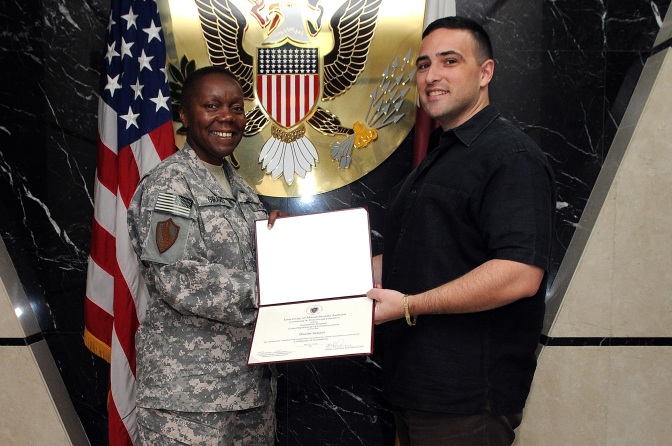
Certificate in Journalism from UMass

I completed a certificate in journalism online from University of Massachusetts May 13, 2010, after taking five online journalism courses. I am grateful for the opportunity to earn a top-notch education, while working 7,000 miles from home. The grades never mattered – I needed to learn. UMass crams a wealth of knowledge into each journalism class; a curriculum well worth the tuition. The instructors are encouraging and accommodating. Norm Sims, an expert in literary journalism, remained responsive and supportive, from online classroom enrollments to ensuring I received appropriate assistance for re-starting my GI Bill benefits. The fundamentals taught immediately helped improve my news reporting and strategic information skills. Continue reading
Friday retreat

“Eight years Dustin,” said Laila, hovering over me with her hands on her hips. “You should know your way around by now. Why do you refuse this system?” Her facial gestures reveal a borderline action: will she storm out of the room in blood-boiling frustration or crack a sympathetic smile?

In my defense, it’ll be seven years next month, but she’s right. I’ve lived in Qatar too long to constantly need driving directions around Doha. I spent 45 minutes this morning looking for the veterinarian to clip our dog’s nails, which is five blocks from our apartment. Continue reading

Fast food in Arabia

Qatar hosts excellent options for prompt, inexpensive and flavorful dining. Grills bundle slowly broiled shavings of chicken and beef wrapped in flatbread with vegetables and garlic paste for two dollars. Dropping 30 cents in a bakery yields stacks of fresh bread. Barbar satisfies hundreds of customers daily, under the tagline “The Lebanese Fast Food,” at the C-Ring and Salwa Road intersection in Doha, known by U.S. expatriates as “cholesterol corner.”

U.S fast food chains suffer on cholesterol corner, where there’s little interest in processed value meals based on canned, smoked, dried and frozen ingredients packed with preservatives. A fading Taco Bell buckled a couple years ago, replaced by a bustling Coffee Beanery. The Arby’s restaurant welcomes “maybe 60 patrons” each day, according to an evening manager. Continue reading

Watching World Cup in Qatar

Laila and I entered a tent adjacent to the Al Bustan Hotel in Doha, Qatar, shortly after 9:30 p.m. during a humid Wednesday night. Split air-conditioning units and tiny wall fans evaded evening temperatures flirting with 100-degrees Fahrenheit. Germany had just started playing Ghana in the FIFA World Cup. Everyone watched the men’s international soccer competition in a traditional Arabic setting.

Laila was raised watching soccer with her father, two sisters and three brothers in Morocco. They surrounded their television, eating salted sunflower seeds and chickpeas. Her mother poured endless cups of Moroccan mint tea the entire 90 minutes. The family screamed with enthusiasm. Her brothers often placed bets at nearby coffee shops. During the World Cup, Laila favored Brazil and Spain, whenever Morocco didn’t play. Continue reading

This is football, real football

Our apartment doorbell rang at 8:45 a.m. Preanta, from Sri Lankan, promptly arrived for Saturday house cleaning duties. Laila handed him supplies, and then returned to bed. We stayed up late last night, after waiting in a long line for an Al Jazeera Sport subscription card inside the Villagio Mall in Doha, Qatar.

“Wake up,” Laila said, an hour later, running between the living room and bedroom. “We need to get ready soon if you want to see a movie… and get groceries.” It’s day two of the FIFA World Cup, one of the most-viewed events in the world. Laila developed a contagious respect for soccer while growing up in Morocco. Continue reading

Washington Welder Tackles Stryker Repair in Qatar

“I tried to join the military – every branch,” said Tad Wendler, from Olympia, Wash., while striking a gas metal arc torch inside the Stryker battle damage repair facility at Camp As Sayliyah, Qatar. “But now I’m serving in another way.”

“I’m protecting soldier’s lives,” said Wendler, a welder responsible for ensuring the integrity of armored combat vehicles for troops on the battlefield. “I cannot be out there with them, but I’m doing my best to ensure they return home safely.”

Wendler, 27, was raised on a 50-acre farm in Rainier, Wash., a 40-minute drive south of Olympia. He helped care for 20 head of cattle, three horses and endless crops. His grandfather started to teach him arc welding at around eight years old. While fixing farm equipment, discussions often led to stories of Army service in the Pacific during World War II. Continue reading

Qatar Sand Dunes

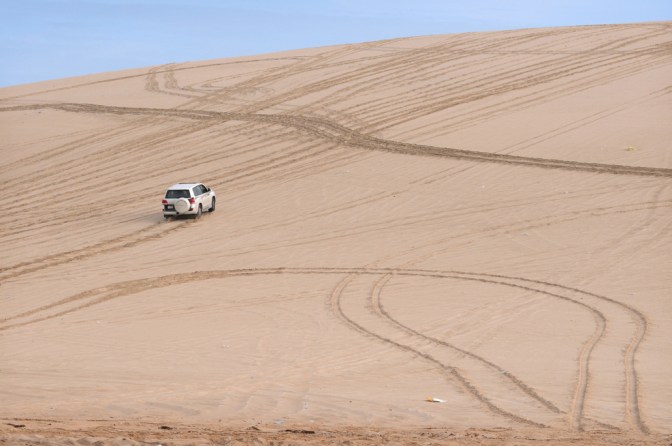
Qatar sand bashing

The Qatar peninsula combines soft and hard terrain, surrounded by the Persian Gulf. The land north of Doha, the capital city, is mostly dust blowing over compact bedrock, where ground excavation requires huge hydraulic jack hammers. The southern region east of Salwa road, the only authorized expressway into Saudi Arabia, is an expedition through enormous slopes of sand.

When driving between continuous sand dunes, the monochromatic landscape looks nearly the same in every direction. Color consistencies camouflage steep cliffs – from a few feet to several hundred meters high – which easily tip unprepared motorists. At times, the only way to penetrate a patch of sand is to build up momentum. Inexperienced drivers who blindly hit the gas are likely to spin out of control and crash. Continue reading

Olympians Share Medals With Troops Overseas

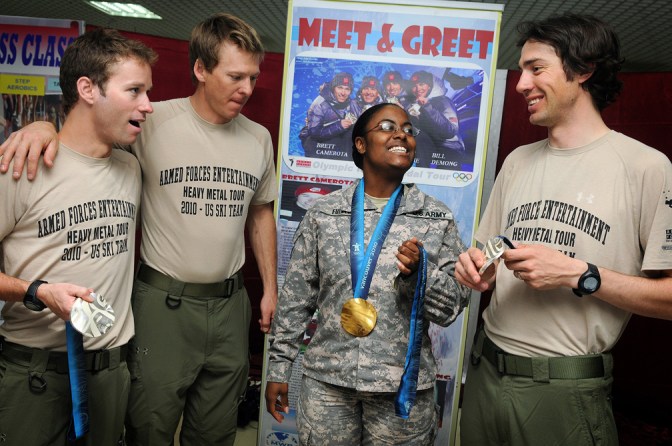
Olympic medalists meet servicemembers overseas

Olympians traveled to Qa­t­ar on April 8 to show servicemembers the first medals earned by the U.S. Nordic Combined Ski Team after 86 years of Winter Olympic competitions.

Four skiers are placing seven Olympic medals, one gold and six silvers, around the necks of U.S. servicemembers in the Middle East as part of the first Armed Forces Entertainment Heavy Medal Tour. The athletes won the medals at the 2010 Vancouver Olympic Games in February.

The Heavy Medal Tour included gold and silver medalist Billy Demong, of Vermontville, N.Y.; and silver medalists Todd Lodwick and Johnny Spillane, of Steamboat Springs, and Brett Camerota, of Park City, Utah. Continue reading

Qatari Merchant

Qatari merchant explains life before the oil

Mohammad Saleh Nishwar, 79, has sold merchandise at Souq Waqif in Doha, Qatar, for more than 60 years. His family-owned store, about the size of a parking space, hasn’t budged in almost 100 years. Reconstruction projects have protected its cultural merit, as part of the oldest trading area in Qatar. Across the street, soaring temples of trade, banking, hospitality and governance are rising from the desert sands, fertilized by seemingly endless fossil fuels. Aside from considerable oil reserves, Qatar has proved 900 trillion cubic feet of natural gas, the largest single gas field under the earth’s crust.

Qatar is a contrast of elements: dull, beige land meets sparkling, blue water. The country protrudes into the Persian Gulf from the Arabian Peninsula. Sand and compact bedrock cover 4,416 square miles. Occasional patches of trees and grass endure the dusty surroundings, which soak up only a few inches of rainfall each year. There are no rivers or lakes, only saline swamps from changing oceanic tides. Continue reading

Moroccan Gnawa

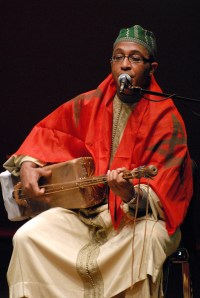
Moroccan cultural exhibition in Doha

Moroccan Gnawa

Moroccan Gnawa

Laila and I watched performers demonstrate traditional dance during a Moroccan Cultural Week at the Qatar National Theater in Doha, March 11-12. The two days were a part of a week-long commemoration of Doha, Capital of Arab Culture 2010. The festivities featured Moroccan jewelry, embroidery and henna tattooing exhibitions as well as events related to cinema, plastic art, traditional music and dance.

Inside a gallery, a Moroccan man was cutting clay tiles with perfect precision using something that resembled an iron anvil. We watched him chip away hexagons and every shape fit perfectly together. Mosaic tiles are a native artistic handiwork of Morocco, which had a lingering affect on art in Spain and Italy, their northern European neighbors. Continue reading