
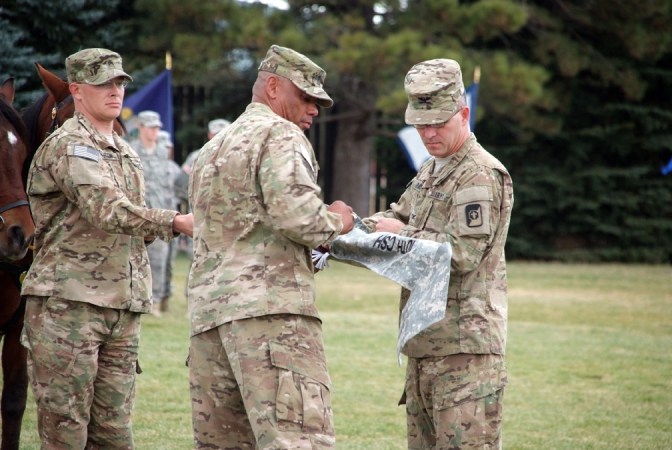
FORT CARSON, Colo. — Almost 150 soldiers stepped into a standing ovation Dec. 4 after returning from Iraq three months early.
Capt. Jeffrey Rawlins, commander of 59th Military Police Company, 759th MP Battalion, entered Waller Physical Fitness Center gymnasium, where he faced bleachers filled with hundreds of family members and friends. Parents, spouses and children were waving “welcome home” banners and balloons. Continue reading

 In a globalized media landscape, the concepts of religious fundamentalism and legislative rights seem to be clashing in similar sacred places, online. Virtual battles between beliefs are occurring within contradictions in public policies and moral values. Resistance to change is sometimes expressed through various kinds of fundamentalism, when interpretations of one’s faith consumes them. Religious leaders and adamant atheists have been spreading their values for thousands of years, and many work passionately to preserve them. Extremists have committed violent attacks, while other fundamentalists recited scriptures and laws encouraging tolerance and upholding civil rights, whenever barraged by adversity. Social media has become a powerful platform for hosting both collaboration and disagreements.


 The Internet is continuing to exert a significant social and economic impact in populations on each of Earth’s continents. The World Wide Web has been changing the way people learn and collaborate since August 1991, when the first website published information explaining hypertext and Web page architecture (Blum, 2011). The Web has persisted in paving virtual highways between people around the world – some sitting thousands of miles apart, others in the same room. But what about those populations that aren’t connected? Africa, the world’s second-largest and second most populated continent in the world, has only 118 million people online, just 11.5 percent of the people – well below the world’s average of 30 percent.