
Humans evolving for violence: Genetics and culture
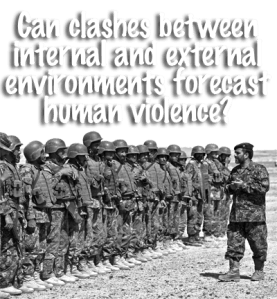 Around the world, humans are exhibiting a great capacity for compassion and social progress, as well as an equally grand tendency for cruelty. With advancements in material culture, our struggles for survival have become exceedingly more complex and unified and violent. According to the Geneva Declaration on Armed Violence and Development (Geneva Declaration Secretariat 2011), a Switzerland-based diplomatic initiative that identifies interrelations between global violence and development, more than 526,000 people die violently each year, of which 396,000 are the result of intentional homicides. One-quarter of those deaths occurred in only 14 countries, where average annual violent death rates exceed 30 per 100,000. Armed violence in non-conflict countries is sometimes more dangerous than combat zones. According to the Geneva Declaration (2011), while U.S.-led coalition troops fought in Iraq between 2004 and 2009, more people per capita were killed in El Salvador. The United Nations (2011) reports some countries have revealed decreased homicide rates in the past 15 years – mainly in Asia, Europe and North America – but their data also shows increases in others (p. 9). Central America and the Caribbean are nearing a “crisis point” (p. 10). Humankind’s constant, sometimes alarming, fluctuations in community homicides has resulted in scientific hypotheses concerning clashes between internal and external environments. Recent research suggests our DNA holds instructions for reacting violently to environmental stress. Continue reading
Earth’s last language?
 For millions of years, humans have mastered climate change and maximized environmental resources to arise as one of the planet’s most adaptable organisms. For hundreds of thousands of years, Homo sapiens have created material culture that’s made it possible to occupy nearly every corner of the Earth. For decades, the species has embarked on extraterrestrial exploration, including the dispatch of a planet-hunting spacecraft capable of picking through countless stars outside our solar system (Thompson 2009). Our collective human intellect combines ideas from around the world. This collaboration has given birth to a powerful economic, political, cultural and environmental phenomenon, called globalization. Globalization is the blending of cultures and commerce through complex innovations. For example, advances in telecommunication technologies are connecting businesses, consumers, scholars and activists. Innovations in automation and computerization are promoting universal standards for efficiency and sustainability. Common sets of communication skills and devices are required for sharing complex concepts. There is a growing momentum for combining languages. Scientists and mathematicians have adopted Arabic numerals for mastering and sharing concepts; it seems we’ll merge vocabularies and grammar too. Continue reading
MPs complete detainee ops in Iraq
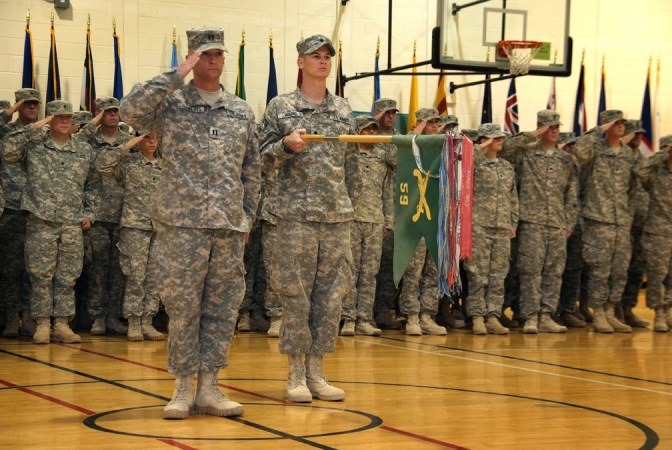
FORT CARSON, Colo. — Almost 150 soldiers stepped into a standing ovation Dec. 4 after returning from Iraq three months early.
Capt. Jeffrey Rawlins, commander of 59th Military Police Company, 759th MP Battalion, entered Waller Physical Fitness Center gymnasium, where he faced bleachers filled with hundreds of family members and friends. Parents, spouses and children were waving “welcome home” banners and balloons. Continue reading

Fundamentalists in social media
 In a globalized media landscape, the concepts of religious fundamentalism and legislative rights seem to be clashing in similar sacred places, online. Virtual battles between beliefs are occurring within contradictions in public policies and moral values. Resistance to change is sometimes expressed through various kinds of fundamentalism, when interpretations of one’s faith consumes them. Religious leaders and adamant atheists have been spreading their values for thousands of years, and many work passionately to preserve them. Extremists have committed violent attacks, while other fundamentalists recited scriptures and laws encouraging tolerance and upholding civil rights, whenever barraged by adversity. Social media has become a powerful platform for hosting both collaboration and disagreements. Continue reading

City unveils bronze battle cross for fallen hero
WOODLAND PARK, Colo. — Dozens of former and current Green Berets gathered in a Rocky Mountain community, Nov. 12, to unveil a bronze battle cross in honor of a local man’s military service.
More than 100 citizens of Woodland Park attended the Veterans Day weekend dedication ceremony, where the city manager, sculptor and the fallen hero’s wife and children uncovered a memorial statue at Lions Park, located at the intersection of U.S. Highway 24 and state Route 67. Continue reading
10th CSH deploys for combat casualty care
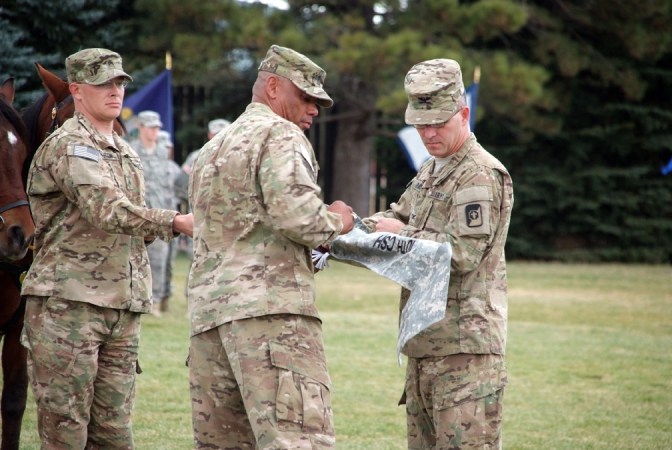
FORT CARSON, Colo. — Hundreds of soldiers from 10th Combat Support Hospital gathered for a casing ceremony, Nov. 4, launching a yearlong lifesaving mission in Afghanistan.
“We will provide the trauma management and hospitalization to the soldiers, sailors, airmen, Marines, coalition members, civilians and, yes, enemy wounded, across nearly one third of Afghanistan,” said Col. Michael Place, 10th CSH commander, after concealing his unit’s colors on Manhart Field. Continue reading

Author visits children of fallen heroes
FORT CARSON, Colo. — An award-winning children’s author and illustrator visited the Fallen Heroes Family Center Oct. 26, to discuss the loss of a loved one.
When Trevor Romain knelt down to share photographs of him petting giraffes and rhinoceroses in Africa, Michael Petersen, 3, reluctantly giggled and then turned toward his mother’s hip. But the slender, upbeat motivational speaker’s mannerisms and South African accent quickly seized the boy’s attention. Continue reading

Survivors visit Fort Carson support center
FORT CARSON, Colo. — More than 100 survivors of servicemembers who died by suicide visited Fort Carson Oct. 23 for an evening gathering at the Fallen Heroes Family Center.
Hundreds of people traveled to Colorado Springs last week for the 3rd Annual National Military Suicide Survivor Seminar and Good Grief Camp, offered by the Tragedy Assistance Program for Survivors. They shared hardships, searched for answers and connected with others for three days at Cheyenne Mountain Resort. Continue reading
Africa: The Internet’s final frontier
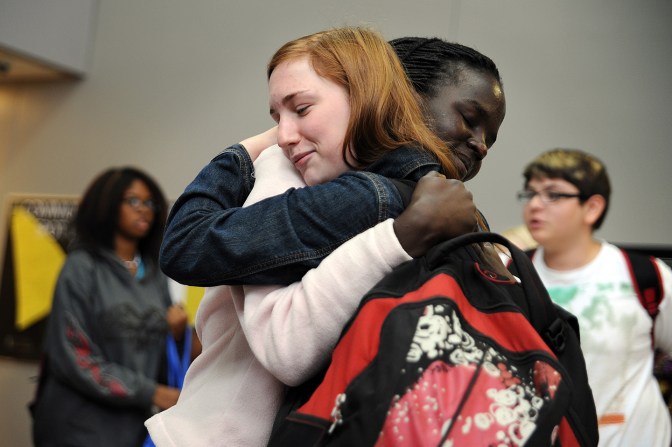
 The Internet is continuing to exert a significant social and economic impact in populations on each of Earth’s continents. The World Wide Web has been changing the way people learn and collaborate since August 1991, when the first website published information explaining hypertext and Web page architecture (Blum, 2011). The Web has persisted in paving virtual highways between people around the world – some sitting thousands of miles apart, others in the same room. But what about those populations that aren’t connected? Africa, the world’s second-largest and second most populated continent in the world, has only 118 million people online, just 11.5 percent of the people – well below the world’s average of 30 percent.
People who are connected are no longer bound by geographical boundaries, separated by political limitations or divided by religious beliefs. Unrestricted access to the Internet allows anyone to rally worldwide compassion for charities, organize populations for global initiatives and conduct international business transactions. According to recent research from the McKinsey Global Institute, e-commerce accounts for the exchange of almost $8 trillion each year. The Internet has accounted for 21 percent of the gross domestic product growth in “matured countries” for more than five years. A McKinsey global Small and Medium Enterprise survey discovered the Internet created 2.4 jobs for each one it destroyed during the past 15 years (Manyika & Roxburgh, 2011). The Web has become an important driver for both economic growth and social progress. Continue reading

Apache battalion prepares for battlefield
FORT CARSON, Colo. — “We have troops in contact. We’re taking fire from a black truck 500 meters northwest, moving eastbound … can’t reposition due to an injured soldier and we’re pinned down.”
That’s one scenario, out of 13, that soldiers from 1st Battalion, 2nd Aviation Regiment, had to master during AH-64D Apache helicopter gunnery exercises, Sept. 27-Oct. 15.

Apache Battalion Prepares for Battle
Videos
Galleries
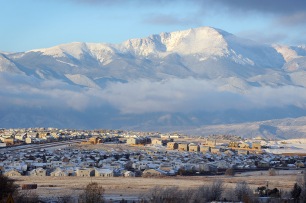
This gallery contains 8 photos.

This gallery contains 13 photos.
Quotes
“Those who want to grow rich in a day live for a long time in great poverty.”
“I think people have been obsessed with the wrong question, which is, ‘How do we make people pay for music?’ What if we started asking, ‘How do we let people pay for music?'”
 Dustin Senger