
Coachee Call 2
During my second call with my dialogue coach, we examined some of my conclusions after exercising David Kantor’s four-player conversation model. Kantor suggests actions a person may take during a conversation: movers initiate ideas and transition the conversation; opposers challenge ideas and the conversation; followers complete ideas and support the conversation; bystanders provide perspective on the ideas and conversation. We also considered the implications of creating a “container” for generative dialogue, and whether that container is considered negative or positive. Continue reading
Reflecting on Four-Player Conversation Model
Dialogue leaders work to keep harmony and productivity within a group discussion, thereby supporting the emergence of generative actions. David Kantor’s four-player conversation model suggests actions a person may take during a conversation: movers initiate ideas and transition the conversation; opposers challenge ideas and the conversation; followers complete ideas and support the conversation; bystanders provide perspective on the ideas and conversation. I recently took part in conversations to consciously explore these roles. Afterward, I theorized that movers and opposers are the actors best suited to set direction. The mover is like a skipper charting new waters, while the opposer drops anchors to explore the current waters. Bystanders and followers mostly provide crew support. I developed two theories related to Web-based, threaded dialogue. First, when a compelling perspective is voiced in online conversations, it causes a pause that opens a door for actors to change roles. Second, followers are less relevant online, where conversations include adequate time to respond and an archive to keep thoughts clear. Continue reading
Coachee Call 1
During my first dialogue with my coach, we explored some of the key processes of coaching: listening, mirroring, summarizing, questioning and catalyzing. Our conversation mostly focused on the first two, listening and mirroring. The former requires a coach to help people see their situation and themselves better. The latter involves inviting them into a period of reflection, diving deeper into the information they’ve shared.
When it comes to public statements, I shared that I’m more of a writer than a talker. As someone who’s successfully managed international public affairs programs, and recently completed a state-level public information officer course, I’m confident in suggesting that I’m more comfortable with carefully researching and writing talking points than speaking them. When making statements in public forums, I prefer a shoot-from-the-hip approach. But I shared a contradiction in my conclusion with my coach. On one hand, I prefer deliberate dialogue; on the other, I’m comfortable with rambling without constraints. My coach weakened my claim of a conflict by suggesting I’m simply most relaxed with developing ideas, relating and connecting. Continue reading
Participatory Media Requires Less Moderating, More Coaching
People are communicating today at a rapid rate, connecting through participatory media. Dialogue coaches are needed to accelerate an online community’s appreciation for its ability to collaborate, acting as a tool that encourages deeper understandings of the exhibited interpersonal skills. They teach ways to uproot attitudes stuck in past experiences and downloaded assumptions, such as simply talking tough or nice. They look at how people conduct a conversation and offer alternatives and feedback, so they may redirect conversations toward more generative and reflective dialogue.
Dialogue coaches strive for deeper understandings. The term “moderator” has been used to define the role of those who accept an authoritative role in online communities, weeding out unwanted behaviors. It’s dangerous to cover up or delete opinions, since the underlying issue is never addressed. Blocking adverse opinions excites their migration to other platforms. For that reason, online collaboration requires dialogue coaches, more than moderators, to keep information sharing activities meaningful, trustworthy. Through listening, coaches learn to appreciate the influence of personality traits online, and not fight them. Correa, Hinsley and De Zuniga found increased social media use in extraverted people, and people open to new experiences (2010). Emotional instability predicted more regular use by men. Since neuroticism is linked to loneliness, it’s likely that anxious and nervous people use social-networking websites to seek support and company. Continue reading

Teens Take on Navy Technology, Engineering Project
PEYTON, Colo. – While controlling an underwater remotely operated vehicle, Te’shon Dickens carefully collected submerged items, confident of his wiring and waterproofing. His team spent more than a month configuring the device.
“This is pretty awesome – making and controlling your own submarine,” said 12-year-old Dickens, standing beside a pool Feb. 22 at Woodmen Hills Recreation Center in Peyton. He’s not a marine robotics technician. He’s a seventh grader at nearby Patriot Learning Center.
“This is the best project I’ve ever done in my life,” said Dickens, after collecting 12 rings during a SeaPerch recovery course, netting 18 points. Across the water, students navigated their configurations of tubes, motors, and wires through a timed obstacle course’s hoops. Continue reading

Girl Scout Tops Cookie Sales Despite Rare Condition
PEYTON, Colo. – As shoppers arrived at a grocery store in Colorado Springs, a girl who cannot speak asked, “Would you like to buy some Girl Scout cookies?”
“Thank you for supporting the Girl Scouts,” said Tyra Young, 10, speaking through her augmented communication device Feb. 12 in Safeway. While raising donations by selling cookies, she giggled, greeted patrons – she danced, Gangnam Style.
“I like selling cookies with her, she’s unique. … She enjoys playing with me,” said Kira-Lynn Lee, 8, sharing a booth with Tyra. They’ll split credit for the evening’s sales. Continue reading
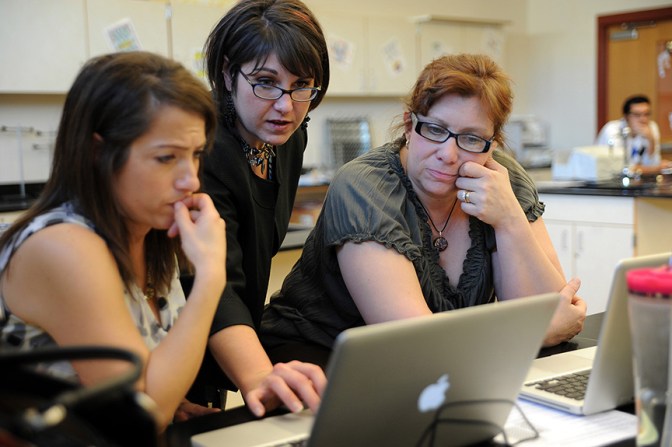
Why an Educator is Flipping Colorado’s Classrooms
PEYTON, Colo. – High school science teacher Jennifer Gray’s curriculum deviates from traditional teaching models – they’re flipped.
“This is a team assignment; you need to work together,” she said, pivoting between groups of four-person tables Feb. 6, during her chemistry class at Vista Ridge High School in Colorado Springs.
Across the room, a student tossed his hand up.
“Did you ask someone to help you yet?” said Gray. When a group got stumped, she’d squat next to the students, guiding them toward answers, inspiring engagement and creativity. Continue reading
2013: New Era of Connectivity, Global Collaboration?
Back in the old days, we shopped in stores, where Black Friday events caused trampling injuries. Our wallets were stuffed with cards for using credit, receiving discounts and unlocking doors. On average, English words were a couple of letters longer. Schools issued books, not tablet computers, and foreign exchange programs required students to actually travel overseas. Tablets relied on batteries, which required a recharge after only a couple of days. Hyperconnected folks stayed mostly tethered to power outlets and WiFi networks. People preferred to record and share events on smartphones, more than take part. Palm-held touchscreen apps helped tech junkies with everything, from infant parenting tactics to finding cheap gas to social activism. There was a lot of political discourse occurring; Congress had an approval rating below that of the United States turning communist. Continue reading

Colorado Students Welcome Winter Break Celebrating Inquiry
PEYTON, Colo. – Students at Evans International Elementary School in Colorado Springs, Colo., welcomed winter break with a midday mix of imagination and foolishness.
The students’ teachers provided a pride assembly Dec. 21, the day before their two-week respite, to promote goal setting, creativity and inquiry, according to assistant principal Michelle Slyter.
“The pride assembly combines all the things the International Baccalaureate is all about,” said Slyter. Evans International Elementary School became an IB world school in 2009, about six years after its faculty held their first pride assembly. Continue reading

Grandfather Heads Back to High School, Earns Diploma
PEYTON, Colo. – Thirty-five years after dropping out of high school in Waterbury, Conn., George Cook was added to a graduation list in Colorado.
Cook, 53, frequently promised his stepfather that he’d eventually earn his high school diploma. He made his final pact in early 2011, a couple of months before the man who had raised him, since 6 years old, died. On Dec. 11, he earned his diploma.
“All the years, I’d talk about going back and getting it,” said Cook, who moved to Colorado in 2008. “But I stayed so busy – sometimes working more than 60 hours per week. I was always exhausted.” Continue reading
Videos
Galleries

This gallery contains 8 photos.

This gallery contains 13 photos.
Quotes
“Those who want to grow rich in a day live for a long time in great poverty.”
“I think people have been obsessed with the wrong question, which is, ‘How do we make people pay for music?’ What if we started asking, ‘How do we let people pay for music?'”
 Dustin Senger